
By PHIL ALLMEN
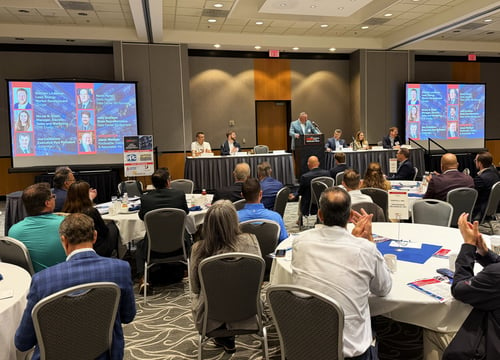
September 23, 2026 - The growth of Michigan’s data center industry was the focus of a September 9th Construction Association of Michigan (CAM) Breakfast Roundtable, which brought together more than 100 industry leaders, legislators, and construction executives at the Somerset Inn in Troy. The event, “Data Centers: Energy, Policy, and What Contractors Need to Know,” examined the factors shaping data center development in Michigan, including energy and water resources, site selection, construction opportunities, community concerns, and state policy.
Presenting sponsors were PPG and Blaze Contracting. Event sponsors were R.S. Dale Company, Sherwin-Williams, and Gardiner C. Vose, Inc.
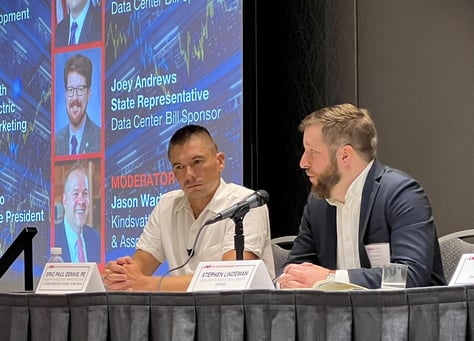
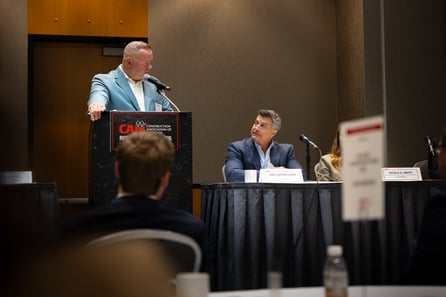
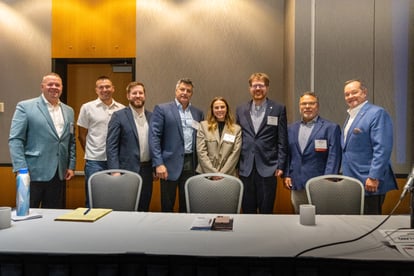 Jason Wadaga, Vice President of Government Affairs with Kindsvatter Dalling & Associates, moderated the discussion, featuring Eric Dennis, analyst with the nonprofit Citizens Research Council of Michigan. Panelists for the roundtable included Joe Castellano, Walbridge Executive Vice President for Operations; Nicole Smith, Manager of Data Center Accounts for DTE Energy; Stephen Lindeman, Lead for Energy Development at Google; and state Rep. Joey Andrews (D-St. Joseph), who has sponsored data center-related legislation in the Michigan House of Representatives.
Why Data Centers Are Booming
Data centers are not a new concept. Private companies are investing billions of dollars in larger and more numerous data center facilities to meet both existing and future needs. This investment supports the expanding digital economy, including e-commerce, streaming, and other cloud-based services that rely on data centers to store and process information. Tech companies are now investing in next-generation AI tools based on large language models (LLMs) that require massive computational capacity. Proponents call data centers a “generational opportunity” for growth.
Companies are competing with one another to develop the best LLMs to add new customers and corner markets. “They're in something of a race with each other to get these big data centers up and running as quickly as possible,” Dennis explained.
Several factors affect data center site selection. Data centers need access to major transmission lines, which are separate from the distribution lines that deliver electricity to homes and businesses. Those transmission lines typically run through less populated areas of the state.
“You might have a site that otherwise looks great, but you have to extend a transmission line miles and miles to get there. And that just doesn't necessarily work,” Smith said on why many companies look to undeveloped, rural areas to build instead of city centers. “Sometimes it's just trying to weigh the pros and cons of each individual site.”
Zoning is another factor. Because companies want to build quickly, a smooth preconstruction process is preferred. Lindeman said that Google chose Van Buren Township for its Project Cannoli data center because the land was already zoned for such use.
“Speed is so critical in the industry right now. Things are moving so quickly that to the extent we can, we're trying to shorten the time frames,” Lindeman said. “If people tell us it takes years, we're trying to shorten that to months everywhere we can. And zoning is one of those areas where that timeline can get extended, certainly.”
Other factors he said companies look at include local community sentiment, power infrastructure, and water infrastructure.
Lindeman and Andrews both said the AI issue is one of national security, as well. AI is becoming increasingly capable of solving complex mathematical problems related to cryptography and encryption. “I ask a lot of people this: ‘Would you rather that China has the ability to break all the world's encryption or the United States have the ability to break all the world's encryption?’ Because that's really the race on a national security perspective,” Andrews said. “Are we willing to let other countries become the ones where this develops and benefit from it? Or are we going to embrace technology and embrace that leadership?”
 Major Opportunities for Contractors
Castellano said that data centers offer a lot of potential for contractors. The scale of the projects, the density of the electrical and plumbing work — as much as 50 percent of the project scope — and the speed at which owners want the projects complete make data centers attractive to prime bidders and subcontractors. “These are mega projects. They take anywhere from 2,500 to 4,000 workers to complete,” he said. “These data center schedules are unprecedented.” For Oracle’s The Barn in Saline, Castellano said the project team is adding $10 million worth of work per day.
DTE’s Smith said that DTE requires construction upgrades for these data center projects, as well. Facilities need to connect to transmission lines, which means extending power lines, substations, or switching stations. Oracle’s project requires 1.4 gigawatts of power; the company will fund 1.4 gigawatts of energy storage in Michigan for DTE’s system, which should benefit both the data center and customers in general. Google will support about 450 megawatts of energy storage and 1,600 megawatts of renewable energy, she added.
“These are gigantic investments that have a really significant impact on communities, on the grid, on construction, and in different skilled trades,” Google’s Lindeman said.
Castellano said that data center projects can serve construction companies long-term. Building a couple data centers in a row could mean a decade’s worth of work for someone in the trades. Lindeman agreed that the projects can provide long-term opportunities for construction workers. As of September 2026, Google was already operating 32 data centers, including one of its oldest and largest facilities in Iowa.
“That particular site has been essentially in permanent construction for 20 years now. We've had crews that began when construction started at that site and are continuing to work on it today as it gets retrofitted, as it gets expanded,” Lindeman said.
Castellano said that Michigan historically offered higher wages than surrounding states, so it was easy to find construction workers from Michigan and the surrounding areas. With high-wage data center jobs underway in neighboring Ohio and Indiana, those workers now are less likely to come to Michigan for work. “We have to find more creative ways to attract new people in the industry and create projects that are more appealing to tradespeople,” he said.
 The increased demand for data center construction is also boosting training opportunities. According to Andrews, IBEW Local 153 in South Bend, Indiana, which also represents union workers in southwest Michigan, recently built a new state-of-the-art training center, and its apprenticeship classes have doubled in size. He said that several unions in his area are seeing an apprenticeship boon because of data center work in Indiana. And that technical work will translate well.
“People are coming off of these jobs with real skills that are transferable to other big projects,” Andrews said. “The training these workers receive on data center projects are going to let us build advanced manufacturing. They’re going to let us build nuclear power plants because we have electricians and plumbers and carpenters who now know how to do this kind of technical advanced work.”
Public Opposition Creates Challenges
Not everyone supports data centers. Throughout Michigan, there’s been some public pushback on data center proposals. The proposals have had mixed results. Some have been approved, while others have been withdrawn or rejected. In a few cases, developers have sued local municipalities to allow construction. The Barn, a sprawling Oracle/OpenAI/Related Digital project in Saline, resulted from a lawsuit against the township.
The Barn is the largest hyperscale data center in the state, but many are much smaller. About 100 data centers are operational in Michigan, but it’s hard to determine a definitive number as they aren’t all registered.
Eric Dennis of the Citizens Research Council of Michigan said that many of the complaints regarding data centers focus more on construction phase disruptions than the data center itself: noise, dust, or trucks. How construction companies protect nearby residents from the impacts of these sites could sway public opinion.
Dennis also addressed two common concerns raised by data center opponents: the power grid and water resources. Critics fear data centers will require an enormous amount of energy, pushing residential rates higher or causing outages elsewhere on the grid. Water is used for cooling purposes, and critics worry that data centers will impact local aquifers and deplete Michigan’s water resources.
Dennis and other panelists said that misinformation has contributed to public opposition. Following the Great Northeast Blackout of 2003, Dennis said there are more regulations on the power grid, which is actively managed to prevent similar large-scale issues. In addition, data center owners are funding power grid improvements, so he suggested their presence is a net benefit for energy consumers. “We're kind of offloading some costs onto them,” he said. Dennis and Smith said increased demand can help reduce electricity costs, although infrastructure investments can add costs.
“Data centers are both a challenge and opportunity for electric grid reliability and cost,” Dennis explained. “But we can get this right — and if you get it right, there are a lot of potential benefits.”
While water resources require careful management, Dennis said concerns that data centers could drain the Great Lakes are hyperbole. He said consumptive water use — water used and not returned to the environment — totals about 500 million gallons. By comparison, the Chicago River draws about 2 billion gallons of water per day.
“Water is a finite resource. We need to value it and take care of it, but we have a lot,” Dennis said.
Castellano said that Walbridge has been involved in data center projects in Virginia, Ohio, Texas, Indiana, and Michigan. The opposition has been most vocal in Michigan. Construction companies interested in the industry should engage with local governments and communities as projects are proposed.
“We have to share the pros, we have to demonstrate how this is a life-changing opportunity for the state of Michigan,” he said, adding that he tells companies that want to work on data centers “you have to be part of the engagement of the community. You have to donate your time … It's actually showing up, being a representative, putting your company flag out there.”
Andrews said that the data center issue “is toxic to voters right now,” but education can mitigate that. “This stuff is being pushed through Facebook and social media circles like crazy, and it is just kind of a toxic pit of misinformation spiraling on itself.”
Town hall meetings and one-on-one conversations can help broaden people’s perspectives, he added. While he may not change opponents into supporters, he said most people at least come to understand that data centers are like any other large project, which can reduce some of the fear surrounding them.
 Michigan Policies and Data Center Investment
Considered a valuable economic development tool, policymakers in Michigan and elsewhere have been adopting policies to attract data centers. Michigan began working in 2023 on a sales and use tax policy intended to attract data centers. A 2024 law subsequently exempted enterprise data centers from state sales and use tax, including taxes on construction materials. Several older laws provide incentives for these companies, as well.
Even with incentives, data centers generate substantial tax revenue, according to Dennis. The Barn will generate an estimated $50 million in tax revenue; Google’s Van Buren Township data center will add about $10 million annually.
Rep. Andrews said that Michigan started work on a favorable sales and use tax to draw data centers to Michigan, bringing construction work, jobs, and tax revenues to the state. Since then, public sentiment has soured, and local municipalities are rejecting companies interested in building here. Now the state is working with data companies, power companies, environmental groups, and labor unions, Andrews said, to reassure the public these projects are being handled responsibly.
“We need to figure out how to put some guardrails in place that are going to make the public feel better about what we're doing and feel protected,” Andrews said. “Every poll shows that the concerns around data centers are about energy use, water use, noise pollution, and transparency.”
Legislators are also considering infrastructure improvements, along with water protections, sound-study rules, bans on nondisclosure agreements, decommissioning funds, and various reporting requirements. Andrews said the goal is to ensure that data centers do not shift infrastructure costs onto the electrical grid. “We’re going to make sure this is a grid subsidy, not a cost,” he said.
“My hope is this can be something that we get done very early next year so that we can put this issue to bed in Michigan and be able to tell everybody we've taken care of (the residents’) concerns,” Andrews said. “Michigan would really be the first state to do this, which means we could be a leader in the industry as far as addressing these concerns and showing the rest of the country how you can do this and still be productive.”
Resources:
View the presentation slides of Eric Dennis, analyst with the nonprofit Citizens Research Council of Michigan
View our event images on Facebook
Upcoming Business-Related Events on the CAM Calendar
Mastering Contract Risks: Identifying and Negotiating Key Clauses
Friday, October 9, 2026, 8:00 a.m.-10:00 a.m.
In this course, attendees will learn a three-step approach to effectively handle risk-shifting clauses in construction contracts.
Business After Hours at Auger Klein Aller Architects
Thursday, October 29, 2026, 4:00 p.m.-6:00 p.m.
Join us at AKA for a Business After Hours event designed to bring the next generation of industry leaders together with the executives helping shape the industry today.
11th Annual Legislative Breakfast
Friday, November 6, 2026, 8:00 a.m.-10:00 a.m.
Hear directly from four Michigan legislators as they discuss the issues and policies affecting the state’s construction industry, with an opportunity for questions and conversation.